“Night shoots, lighting, cars, effects, ending the world on a 3.7 budget.”
— Steve De Jarnatt, writer & director of MIRACLE MILE
Cities do not stop once the sun goes down. They may begin acting under a different set of rules, but they certainly do not cease activity like the suburbs. Streets need to be cleaned. Buildings need to be maintained. Drunks need to loiter. Junkies need to shoot up. Cops need to stick their noses in places they don’t belong. Stockbrokers need to get to work. Cabbies need to clean vomit off their back seats. Everybody’s guzzling coffee like the bean’s going extinct.
With night comes a certain kind of freedom. No longer are we rudely assaulted by a giant flame in the sky. We can walk without squinting. The threat of sweat ruining clothes and burning eyes diminishes. Everybody’s fueled by a thrill that anything can happen under cover of darkness.
Days only seem long when absolutely nothing happens. Nights, on the other hand, protract with added turmoil. Time stretches like hand-me-down silly putty.
The shortest day is the day Harry Washello meets Julie Peters, and the longest night is the night the world ends.

Like every great story, the premise of MIRACLE MILE is simple and one as old as time: Boy Meets Girl, Nukes Destroy the World. The structure is schizophrenic and eager to spit on its audience. A layer of innocence walks us through the beginning, misguiding its viewers into a false sense of optimism.
The film opens like a romantic comedy. Harry Washello (Anthony Edwards, fresh off TOP GUN) is a trombonist performing at a charity event for the Pan-Pacific Auditorium in Los Angeles. Julie Peters (Mare Winningham, ST. ELMO’S FIRE) is a waitress at a local coffee shop who happens to be hanging out at the same museum. All morning they steal glances at each other without saying anything until fate once again pushes them together out in front of the La Brea Tar Pits. They get to talking and chemistry instantly ignites. Together they stroll the town. At a seafood restaurant, Julie frowns at their tank of lobsters, so he shows off by spending a ridiculous amount of money buying them all and tossing them off a pier. Could this be love at first sight? It’s certainly what the film wants its viewer to believe, and you know what? It’s doing a pretty convincing job. It helps that Anthony Edwards and Mare Winningham had been good friends since they were teenagers. Nothing about their sudden closeness feels forced.

Harry’s blue suit pops like cotton candy on an overcast day as their exploration continues. Blue plays a big role in MIRACLE MILE. Pay attention and you start noticing it everywhere. Blue suits, blue buses, blue balloons, blue pay phones, blue elevator walls, blue sirens, blue convertibles…If color were a character, blue would be this film’s protagonist. Is the color following Harry, or is Harry following the color? Maybe they’re one and the same; a witness to something far beyond their control.
Harry and Julie agree on a second date later that night, after her shift at Johnie’s Coffee Shop. He walks back home feeling like the luckiest guy in the world. At this rate, nothing could possibly go wrong.
Not long after shooting at the Pan-Pacific Auditorium, a homeless man burned the building down with a Sterno, marking MIRACLE MILE as its final film appearance.
Nothing lasts.
Especially the good things.
Harry would have done well to remember that.
humor to confusion to anger to fear. Johnie’s hosts an excellent cast of weirdos who make this universe their own. Everybody’s so natural and confident in their roles, the viewer wouldn’t be disappointed to backtrack and see how they all ended up here together. The moment Harry stumbles through the door, post-phone call, confused and scared, the entire tone of the film has been knocked off-kilter. The viewer feels just as unsure as our protagonist. This was supposed to be a sad sappy sucker love story. Now Los Angeles might be under risk of nuclear attack? That’s not how movies are supposed to work. That’s not how anything’s supposed to work. Steve De Jarnatt knows this and he doesn’t give a single goddamn. Screw the rules.

The diner staff loads up on food supplies and everybody piles into a van. Their only chance of survival’s waiting at the airport, and it won’t be there forever.
For the longest time, you start forgetting this started out as a love story, then Harry remembers Julie is still out there somewhere. The van driver refuses to make any detours, so Harry leaps out of the back of the van with a handgun. He rolls across an onramp and nearly gets mangled by a passing pair of motorcycles resembling two glowing eyes charging in the darkness. The next vehicle to approach him slams on its brakes at the sight of Harry’s gun. A blue convertible driven by a very long stereo thief in a blue tracksuit, played by Mykelti Williamson (misspelled as Mykel T. Williamson in the credits). Harry hops in the passenger’s seat and orders him to turn around and head back toward the La Brea Apartments (shot on location!) where he knows Julie lives. He warns Williamson’s character, Wilson, of the city’s impending doom, but his convertible is running low on gas, certainly not enough in the tank to pick up Julie and return to the airport.
MIRACLE MILE is an anomaly. Unlike other films of its time, it presents the city not as gritty or foggy. Everything is…clean and clear. A neon haze brings us back to the Hollywood of the 1960s. But with that said, De Jarnatt isn’t afraid to make his characters sweat. Clothes get drenched and filthy. Windows fog from heavy breathing and glare against passing lights. This is a film out of its time.
They stop at a station strictly reserved for taxi drivers. Things get out of hand fast and Wilson drenches two cops with gasoline. Blinded, they start firing their guns, which only ignites the fuel dripping from their bodies. Flame consumes flesh. The pyro dance begins. Shooting off guns blindly, you’re gonna blow yourself up; De Jarnatt fine-tuning metaphors every step of the way. Harry and Wilson escaping just as the gas station explodes behind them, a mushroom cloud shooting up into the sky. Mushroom clouds plague this film like doomsday easter eggs.
Clock ticking, they floor it to Julie’s.
* * *
Steve De Jarnatt wrote the MIRACLE MILE script while blaring Tangerine Dream’s SORCERER soundtrack, so it makes sense that they’d end up scoring his movie, too. He sent them a rough cut of the film ten years after originally writing it, thinking there’d be no chance in hell they’d bite, only to be proven wrong. Suddenly he found himself in Vienna, working together with the band as they created a solid mix. If the color blue acts as the protagonist of MIRACLE MILE, then the music is its love interest. Without Tangerine Dream, this film dies before it even begins. The score’s largely responsible for lulling its viewer into the beginning’s innocent romance, then abruptly slapping you in the face with ticking clocks and synth intensity. The reason your heart’s beating so fast as Harry races around Los Angeles is the music doesn’t give you a chance to breathe. You’re right there in it with him, feeling that doomsday ticker near its end goal.
* * *
In an early version of MIRACLE MILE, the character of Harry Washello was meant to be an older fella—still a trombonist—from out of town, hasn’t been back in fifteen years or so, and he’s still obsessed with his ex, and after discovering what’s about to happen in L.A., he figures this is his last chance to save her and show him he’s not a total shithead after all. This storyline ended up getting sorta recycled into Julie’s grandparents. They haven’t spoken in over a decade, yet they live in the same apartment complex. Only after everything goes to hell do they reunite, but they refuse to join Harry and Julie to a nearby helicopter he’s arranged to pick them up. Instead they’d rather drive up to a diner and have breakfast together one last time. They’ve accepted their fate, and they’d prefer to end things side by side before it’s too late. Are those tears running down your face? Get used to them. They’re staying awhile.
Harry pushes a drugged-up Julie in a shopping cart through a dreamlike L.A. Reflections bounce off walls and eyeglasses and windows. Everywhere you look, there’s something hidden in its depths. It’s at this point the sky becomes its own ticking clock as it slowly mutates into something ominous and murky. Landa’s pulled some strings and has a helicopter waiting for them atop the Mutual Benefit Life Building. Her associate, Kurt Fuller (in his first film role!), is the angriest asshole in the world. He’s waiting up there with a stack of cash instructed to hand over to the pilot, but the pilot’s a no-show, so Harry drops off Julie and races through the city intent on fixing the issue. A wonderful scene follows once he reaches the bottom of the building: Julie, on the roof, screaming Harry’s name; Harry staring back up, realizing once again they’ve been separated by a nauseating distance. Fuck it. Gotta move forward. Can’t save her without a pilot. Otherwise this would have all been for nothing.

Cut to a near-uninterrupted scene as Harry barges into a twenty-four-hour gym and screams over and over, “Can anybody here fly a helicopter?” To get everybody’s attention, he shoots a turntable to death. The music abruptly cuts off. Screams follow. Yoga instructors and bodybuilders stampeding out of the building. Only one person sticks behind, an unnamed bodybuilder who claims to be a pilot, played by Brian Thompson (whose father happened to be Steve De Jarnatt’s oceanography teacher). Harry gives him a slightly adjusted version of the truth. The pilot retrieves his boyfriend and the three of them flee back to Mutual Benefit Life Building. More points need to go toward Steve De Jarnatt here. Remember: MIRACLE MILE came out in 1989, and it contains not only two gay characters, but also someone in the trans community, and all three of them are treated with complete respect. They aren’t in the film to serve as the butt of some ill-advised joke. Instead they’re just as developed as the rest of the cast, offering a really unique atmosphere to an already slick-as-hell roster.
On the way back to the building, Harry spots Julie fleeing down the street. He tells the pilot he’ll meet him in a couple minutes and follows after the love of his life. What follows is absolute chaos. Wilson the stereo thief crashes a stolen cop car into the window of a department store. Harry and Julie investigate and find Wilson holding his dying sister on a backwards escalator pulling him back down because there’s no escaping the inevitable, one tear slowly dripping down his face as life leaves his body. An hour’s already passed and Harry’s standing above Wilson’s corpse realizing that maybe he was wrong, that the guy on the phone was just fucking with him after all, why hasn’t anything happened? How much death and mayhem has he caused this city by spreading some lunatic’s story? Harry and Julie having a moment of truth inside a room covered wall-to-wall with literal ticking tocks. Outside, cops surround the building. The fun’s up. Time to surrender. He walks out with his arms raised, blue suit layered with filth, camera focused solely on Harry and refusing to acknowledge what’s going on out on the street as chaotic noises fill the speaker. By the time Harry walks out of the store, cop cars are already booking it down the street. A sniper tumbles from a zip line onto the sidewalk and runs for it.
Exit: night. Enter: Armageddon.
Traffic gets nuts. People riot in the streets. Cars explode. Everything Harry’s been warning the city about, it’s finally happening. He’s almost relieved, as fucked up as it sounds. Think about it: if nothing happened, then he’s responsible for multiple deaths and a shit ton of damage. But something is happening, freeing him of guilt. In fact, he’s a hero again. He’s the guy who saved everybody at Johnie’s. He’s the guy who saved Julie. Or at least tried to.
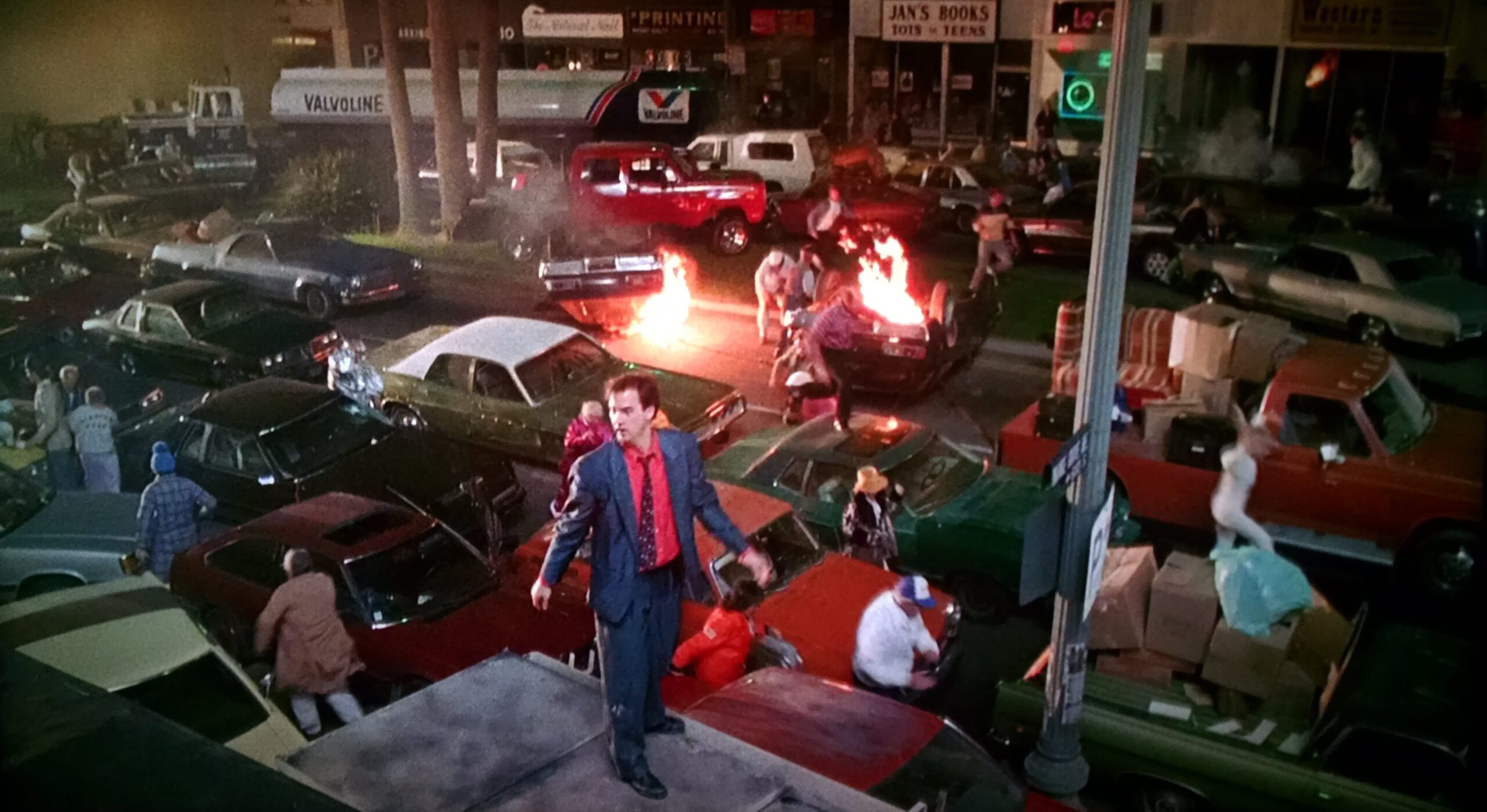
Harry races through the city again, climbing over cars and pushing maniacs out of his way. Every frame of this madness ought to be a poster. An onslaught of display TVs inside a storefront window broadcast an anchorman warning the world of its demise. In previous drafts, this man was meant to be played by Walter Cronkite. He’d start reporting apocalyptic events before saying, “Fuck it!” on live TV and walking off camera. De Jarnatt claims Cronkite read the script and gave it some serious thought before ultimately declining. Back on the TV, someone shoots a newsman and his camera shatters on the ground. Harry climbs up on another car as chaos unfolds from every direction. If you’ve seen the film poster then you’ve seen this shot. It spoilers the entire film but sometimes spoilers are worth it. It’s the kind of visual that makes the One Perfect Shot twitter account come in its pants.
Harry pisses off the driver of the car he’s standing on and a chase ensues, leaving Harry with no choice but to escape into the sewer and flee through a toxic tunnel. During these shoots, most of the crew left and refused to work under such dangerous risks of disease. Anthony Edwards would leave this scene with one hell of a rash, but otherwise everybody was fine.
Harry and Julie reunite at Johnie’s, back where they were supposed to originally meet. Only an hour has passed since Harry last entered this building but it feels like an eternity. Outside the restaurant, a statue mascot named Fat Boy witnesses the apocalypse, bringing to mind Fat Man, the nuke that destroyed Nagasaki in 1945. Everything repeats. There is no escape. Inside Johnie’s a homeless person sits at the counter while a coyote feasts on garbage. Everybody else in this city is losing their minds, but these two, they’re just enjoying the new vacancy.

Harry and Julie leave them alone and return to the Mutual Benefit Life Building. A beautiful long shot follows as the elevator takes far too long rising to the roof: Harry and Julie holding hands, locking eyes, kissing, undressing, deciding fuck it, if they’re going to die then they’re going to die the proper way. Then: the elevator opens. Bright, red sky. Everything is burning. You can feel the sun scorching your flesh. The helicopter’s gone but Kurt Fuller’s still hanging around, still acting like a fucking lunatic. He’s shirtless and drunk and maybe they just interrupted him raping a corpse? It’s unclear, and the director refuses to confirm one way or another. Maniacal shadows follow him as he dances around the roof, screaming at god and anybody else who’ll listen.
But the helicopter returns, and the audience lets out a sigh of relief. The pilot’s come back, just like he promised. Harry and Julie jump in and they take off again, leaving Kurt Fuller to experience the missiles alone. The sky explodes. Kurt Fuller watches the flames consume surround him, laughing hysterically as his eyeballs melt from his skull. Fun fact: to achieve this gnarly special effect, they placed a very bright light in front of him and a raw egg in each hand. Then he just…smashed them into his face.

That’s dedication, folks.
* * *
The original draft for MIRACLE MILE involved the first missile landing only six blocks away from the building and not going off. Evidently, one-third of Russian bombs were actually duds. So, we’d once again get lulled into this false optimism. For whatever reason, that was cut, and the first missile does the job pretty damn well.
The helicopter doesn’t make it very far before the inevitable reaches them once again and the film, ever dedicated to symmetry, returns to the La Brea Tar Pits. They crash directly into the black pool as flames replace clouds. Ironically enough, this scene was shot on the same day of the infamous TWILIGHT ZONE court case (involving the death of several children over a helicopter accident).
Harry and Julie find themselves half-submerged in the tar pits, trapped within the confines of the crashed helicopter. They’re staring not just at each other, but directly into the camera lens, at you, the audience, as if to ask us: Is this really happening? Is this…is this it? Where’s our happy ending, goddammit? Where’s our fairy tale?
Will the tar preserve their bones like it has so many other animals over the past centuries? Will it keep them locked together in one last embrace as the rest of the world melts and decomposes around them?
Honestly, at this point, it’s the best outcome they could possibly hope for.
Note: This essay was written a couple years ago for a different website, and it’s since been reprinted on my Letterboxd, too. But I wanted to give it a more proper home, so here it shall live.
Leave a Reply
You must be logged in to post a comment.